A indústria de apostas esportivas online está crescendo rapidamente, com cada vez mais opções disponíveis para os apostadores. No entanto, é fundamental escolher uma plataforma licenciada e regulamentada para garantir uma experiência segura e protegida. Neste artigo, vamos discutir como escolher apostas esportivas em plataformas licenciadas e fornecer recomendações úteis para os apostadores. Ao escolher uma plataforma de apostas esportivas, é essencial verificar se ela possui uma licença adequada. As plataformas licenciadas são regulamentadas por autoridades governamentais e devem cumprir determinados padrões de segurança e fair play. Isso garante que os apostadores estejam protegidos contra fraudes e manipulações. Além da licença, é importante verificar a reputação da plataforma. Procure por avaliações de outros jogadores, verifique se a empresa possui um bom histórico e se há reclamações ou problemas recorrentes. Uma plataforma confiável e respeitada será transparente sobre suas práticas e terá um excelente serviço ao cliente. Outro aspecto a considerar ao escolher uma plataforma de apostas esportivas é a variedade de esportes e mercados disponíveis. Apostar em um esporte que você conhece e entende aumenta suas chances de sucesso. Além disso, uma ampla gama de mercados oferece mais oportunidades de apostas e pode aumentar a diversão do jogo. Para apostadores iniciantes, é aconselhável começar com apostas simples e de baixo risco. Conforme você ganha confiança e experiência, pode começar a explorar apostas mais complexas e arriscadas. Lembre-se sempre de definir um orçamento e não apostar mais do que você pode perder. Por fim, é importante estar ciente dos bônus e promoções oferecidos pelas plataformas de apostas esportivas. Essas ofertas podem proporcionar um impulso extra ao seu bankroll e aumentar suas chances de ganhar. No entanto, certifique-se de ler os termos e condições associados a essas promoções para evitar surpresas desagradáveis. Em resumo, ao escolher apostas esportivas em plataformas licenciadas, é crucial considerar a licença, reputação, variedade de esportes, tipos de apostas, gerenciamento de bankroll e bônus disponíveis. Seguindo essas recomendações úteis, os apostadores podem desfrutar de uma experiência segura e emocionante ao apostar em seus esportes favoritos. Recomendações úteis para escolher apostas esportivas em plataformas licenciadas:
Verifique se a plataforma possui uma licença adequada e é regulamentada.
Pesquise a reputação da empresa e verifique se há reclamações ou problemas recorrentes.
Escolha uma plataforma com uma ampla variedade de esportes e mercados.
Comece com apostas simples e de baixo risco para aprender o processo.
Defina um orçamento e não exceda seulimites financeiros.
Aproveite os bônus e promoções, mas esteja ciente dos termos e condições.
A indústria de apostas esportivas online está crescendo rapidamente, com cada vez mais opções disponíveis para os apostadores. No entanto, é fundamental escolher uma plataforma licenciada e regulamentada para garantir uma experiência segura e protegida. Neste artigo, vamos discutir como escolher apostas esportivas em plataformas licenciadas e fornecer recomendações úteis para os apostadores. Ao escolher uma plataforma de apostas esportivas, é essencial verificar se ela possui uma licença adequada. As plataformas licenciadas são regulamentadas por autoridades governamentais e devem cumprir determinados padrões de segurança e fair play. Isso garante que os apostadores estejam protegidos contra fraudes e manipulações. Além da licença, é importante verificar a reputação da plataforma. Procure por avaliações de outros jogadores, verifique se a empresa possui um bom histórico e se há reclamações ou problemas recorrentes. Uma plataforma confiável e respeitada será transparente sobre suas práticas e terá um excelente serviço ao cliente. Outro aspecto a considerar ao escolher uma plataforma de apostas esportivas é a variedade de esportes e mercados disponíveis. Apostar em um esporte que você conhece e entende aumenta suas chances de sucesso. Além disso, uma ampla gama de mercados oferece mais oportunidades de apostas e pode aumentar a diversão do jogo. Para apostadores iniciantes, é aconselhável começar com apostas simples e de baixo risco. Conforme você ganha confiança e experiência, pode começar a explorar apostas mais complexas e arriscadas. Lembre-se sempre de definir um orçamento e não apostar mais do que você pode perder. Por fim, é importante estar ciente dos bônus e promoções oferecidos pelas plataformas de apostas esportivas. Essas ofertas podem proporcionar um impulso extra ao seu bankroll e aumentar suas chances de ganhar. No entanto, certifique-se de ler os termos e condições associados a essas promoções para evitar surpresas desagradáveis. Em resumo, ao escolher apostas esportivas em plataformas licenciadas, é crucial considerar a licença, reputação, variedade de esportes, tipos de apostas, gerenciamento de bankroll e bônus disponíveis. Seguindo essas recomendações úteis, os apostadores podem desfrutar de uma experiência segura e emocionante ao apostar em seus esportes favoritos. Recomendações úteis para escolher apostas esportivas em plataformas licenciadas:
Verifique se a plataforma possui uma licença adequada e é regulamentada.
Pesquise a reputação da empresa e verifique se há reclamações ou problemas recorrentes.
Escolha uma plataforma com uma ampla variedade de esportes e mercados.
Comece com apostas simples e de baixo risco para aprender o processo.
Defina um orçamento e não exceda seulimites financeiros.
Aproveite os bônus e promoções, mas esteja ciente dos termos e condições.
A indústria de apostas esportivas online está crescendo rapidamente, com cada vez mais opções disponíveis para os apostadores. No entanto, é fundamental escolher uma plataforma licenciada e regulamentada para garantir uma experiência segura e protegida. Neste artigo, vamos discutir como escolher apostas esportivas em plataformas licenciadas e fornecer recomendações úteis para os apostadores. Ao escolher uma plataforma de apostas esportivas, é essencial verificar se ela possui uma licença adequada. As plataformas licenciadas são regulamentadas por autoridades governamentais e devem cumprir determinados padrões de segurança e fair play. Isso garante que os apostadores estejam protegidos contra fraudes e manipulações. Além da licença, é importante verificar a reputação da plataforma. Procure por avaliações de outros jogadores, verifique se a empresa possui um bom histórico e se há reclamações ou problemas recorrentes. Uma plataforma confiável e respeitada será transparente sobre suas práticas e terá um excelente serviço ao cliente. Outro aspecto a considerar ao escolher uma plataforma de apostas esportivas é a variedade de esportes e mercados disponíveis. Apostar em um esporte que você conhece e entende aumenta suas chances de sucesso. Além disso, uma ampla gama de mercados oferece mais oportunidades de apostas e pode aumentar a diversão do jogo. Para apostadores iniciantes, é aconselhável começar com apostas simples e de baixo risco. Conforme você ganha confiança e experiência, pode começar a explorar apostas mais complexas e arriscadas. Lembre-se sempre de definir um orçamento e não apostar mais do que você pode perder. Por fim, é importante estar ciente dos bônus e promoções oferecidos pelas plataformas de apostas esportivas. Essas ofertas podem proporcionar um impulso extra ao seu bankroll e aumentar suas chances de ganhar. No entanto, certifique-se de ler os termos e condições associados a essas promoções para evitar surpresas desagradáveis. Em resumo, ao escolher apostas esportivas em plataformas licenciadas, é crucial considerar a licença, reputação, variedade de esportes, tipos de apostas, gerenciamento de bankroll e bônus disponíveis. Seguindo essas recomendações úteis, os apostadores podem desfrutar de uma experiência segura e emocionante ao apostar em seus esportes favoritos. Recomendações úteis para escolher apostas esportivas em plataformas licenciadas:
Verifique se a plataforma possui uma licença adequada e é regulamentada.
Pesquise a reputação da empresa e verifique se há reclamações ou problemas recorrentes.
Escolha uma plataforma com uma ampla variedade de esportes e mercados.
Comece com apostas simples e de baixo risco para aprender o processo.
Defina um orçamento e não exceda seulimites financeiros.
Aproveite os bônus e promoções, mas esteja ciente dos termos e condições.
YouTube is one of the most influential platforms in modern media, but its origin story is surprisingly simple: a small team wanted an easier way to share video online. In the early 2000s, uploading and sending video files was slow, formats were inconsistent, and most websites weren’t built for smooth playback. YouTube’s founders focused on removing those barriers—making video sharing as easy as sending a link.
Who Founded YouTube?
YouTube was founded by three former PayPal employees: Chad Hurley, Steve Chen, and Jawed Karim. They combined product thinking, engineering skills, and a clear user goal: create a website where anyone could upload a video and watch it instantly in a browser.
Chad Hurley — product/design focus and early CEO role
Steve Chen — engineering and infrastructure
Jawed Karim — engineering and early concept support
The Problem YouTube Solved
At the time, sharing video often meant emailing huge files or dealing with complicated players and downloads. YouTube made video:
Uploadable by non-experts (simple interface)
Streamable in the browser (no special setup)
Sharable through links and embedding on other sites
Early Growth and the First Video
YouTube launched publicly in 2005. One of the most famous early moments was the first uploaded video, “Me at the zoo,” featuring co-founder Jawed Karim. The clip was short and casual—exactly the kind of everyday content that proved the platform’s big idea: ordinary people could publish video without needing a studio.
Key Milestones Timeline
Year/Date
Milestone
Why It Mattered
2005
YouTube is founded and launches
Introduced easy browser-based video sharing
2005
“Me at the zoo” is uploaded
Became a symbol of user-generated video culture
2006
Google acquires YouTube
Provided resources to scale hosting and global reach
Why Google Bought YouTube
By 2006, YouTube’s traffic was exploding. Video hosting is expensive—bandwidth and storage costs rise fast when millions of people watch content daily. Google’s acquisition gave YouTube the infrastructure and advertising ecosystem to grow into a sustainable business.
What YouTube’s Founding Changed
YouTube didn’t just create a popular website; it reshaped how people learn, entertain themselves, and build careers online. Its founding helped accelerate:
Creator-driven media and influencer culture
How-to education and free tutorials at massive scale
Music discovery, commentary, and global community trends
From a small startup idea to a global video powerhouse, YouTube’s founding is a classic example of a simple product solving a real problem—and changing the internet in the process.
YouTube is one of the most influential platforms in modern media, but its origin story is surprisingly simple: a small team wanted an easier way to share video online. In the early 2000s, uploading and sending video files was slow, formats were inconsistent, and most websites weren’t built for smooth playback. YouTube’s founders focused on removing those barriers—making video sharing as easy as sending a link.
Who Founded YouTube?
YouTube was founded by three former PayPal employees: Chad Hurley, Steve Chen, and Jawed Karim. They combined product thinking, engineering skills, and a clear user goal: create a website where anyone could upload a video and watch it instantly in a browser.
Chad Hurley — product/design focus and early CEO role
Steve Chen — engineering and infrastructure
Jawed Karim — engineering and early concept support
The Problem YouTube Solved
At the time, sharing video often meant emailing huge files or dealing with complicated players and downloads. YouTube made video:
Uploadable by non-experts (simple interface)
Streamable in the browser (no special setup)
Sharable through links and embedding on other sites
Early Growth and the First Video
YouTube launched publicly in 2005. One of the most famous early moments was the first uploaded video, “Me at the zoo,” featuring co-founder Jawed Karim. The clip was short and casual—exactly the kind of everyday content that proved the platform’s big idea: ordinary people could publish video without needing a studio.
Key Milestones Timeline
Year/Date
Milestone
Why It Mattered
2005
YouTube is founded and launches
Introduced easy browser-based video sharing
2005
“Me at the zoo” is uploaded
Became a symbol of user-generated video culture
2006
Google acquires YouTube
Provided resources to scale hosting and global reach
Why Google Bought YouTube
By 2006, YouTube’s traffic was exploding. Video hosting is expensive—bandwidth and storage costs rise fast when millions of people watch content daily. Google’s acquisition gave YouTube the infrastructure and advertising ecosystem to grow into a sustainable business.
What YouTube’s Founding Changed
YouTube didn’t just create a popular website; it reshaped how people learn, entertain themselves, and build careers online. Its founding helped accelerate:
Creator-driven media and influencer culture
How-to education and free tutorials at massive scale
Music discovery, commentary, and global community trends
From a small startup idea to a global video powerhouse, YouTube’s founding is a classic example of a simple product solving a real problem—and changing the internet in the process.
YouTube is one of the most influential platforms in modern media, but its origin story is surprisingly simple: a small team wanted an easier way to share video online. In the early 2000s, uploading and sending video files was slow, formats were inconsistent, and most websites weren’t built for smooth playback. YouTube’s founders focused on removing those barriers—making video sharing as easy as sending a link.
Who Founded YouTube?
YouTube was founded by three former PayPal employees: Chad Hurley, Steve Chen, and Jawed Karim. They combined product thinking, engineering skills, and a clear user goal: create a website where anyone could upload a video and watch it instantly in a browser.
Chad Hurley — product/design focus and early CEO role
Steve Chen — engineering and infrastructure
Jawed Karim — engineering and early concept support
The Problem YouTube Solved
At the time, sharing video often meant emailing huge files or dealing with complicated players and downloads. YouTube made video:
Uploadable by non-experts (simple interface)
Streamable in the browser (no special setup)
Sharable through links and embedding on other sites
Early Growth and the First Video
YouTube launched publicly in 2005. One of the most famous early moments was the first uploaded video, “Me at the zoo,” featuring co-founder Jawed Karim. The clip was short and casual—exactly the kind of everyday content that proved the platform’s big idea: ordinary people could publish video without needing a studio.
Key Milestones Timeline
Year/Date
Milestone
Why It Mattered
2005
YouTube is founded and launches
Introduced easy browser-based video sharing
2005
“Me at the zoo” is uploaded
Became a symbol of user-generated video culture
2006
Google acquires YouTube
Provided resources to scale hosting and global reach
Why Google Bought YouTube
By 2006, YouTube’s traffic was exploding. Video hosting is expensive—bandwidth and storage costs rise fast when millions of people watch content daily. Google’s acquisition gave YouTube the infrastructure and advertising ecosystem to grow into a sustainable business.
What YouTube’s Founding Changed
YouTube didn’t just create a popular website; it reshaped how people learn, entertain themselves, and build careers online. Its founding helped accelerate:
Creator-driven media and influencer culture
How-to education and free tutorials at massive scale
Music discovery, commentary, and global community trends
From a small startup idea to a global video powerhouse, YouTube’s founding is a classic example of a simple product solving a real problem—and changing the internet in the process.
YouTube is one of the most influential platforms in modern media, but its origin story is surprisingly simple: a small team wanted an easier way to share video online. In the early 2000s, uploading and sending video files was slow, formats were inconsistent, and most websites weren’t built for smooth playback. YouTube’s founders focused on removing those barriers—making video sharing as easy as sending a link.
Who Founded YouTube?
YouTube was founded by three former PayPal employees: Chad Hurley, Steve Chen, and Jawed Karim. They combined product thinking, engineering skills, and a clear user goal: create a website where anyone could upload a video and watch it instantly in a browser.
Chad Hurley — product/design focus and early CEO role
Steve Chen — engineering and infrastructure
Jawed Karim — engineering and early concept support
The Problem YouTube Solved
At the time, sharing video often meant emailing huge files or dealing with complicated players and downloads. YouTube made video:
Uploadable by non-experts (simple interface)
Streamable in the browser (no special setup)
Sharable through links and embedding on other sites
Early Growth and the First Video
YouTube launched publicly in 2005. One of the most famous early moments was the first uploaded video, “Me at the zoo,” featuring co-founder Jawed Karim. The clip was short and casual—exactly the kind of everyday content that proved the platform’s big idea: ordinary people could publish video without needing a studio.
Key Milestones Timeline
Year/Date
Milestone
Why It Mattered
2005
YouTube is founded and launches
Introduced easy browser-based video sharing
2005
“Me at the zoo” is uploaded
Became a symbol of user-generated video culture
2006
Google acquires YouTube
Provided resources to scale hosting and global reach
Why Google Bought YouTube
By 2006, YouTube’s traffic was exploding. Video hosting is expensive—bandwidth and storage costs rise fast when millions of people watch content daily. Google’s acquisition gave YouTube the infrastructure and advertising ecosystem to grow into a sustainable business.
What YouTube’s Founding Changed
YouTube didn’t just create a popular website; it reshaped how people learn, entertain themselves, and build careers online. Its founding helped accelerate:
Creator-driven media and influencer culture
How-to education and free tutorials at massive scale
Music discovery, commentary, and global community trends
From a small startup idea to a global video powerhouse, YouTube’s founding is a classic example of a simple product solving a real problem—and changing the internet in the process.
YouTube is one of the most influential platforms in modern media, but its origin story is surprisingly simple: a small team wanted an easier way to share video online. In the early 2000s, uploading and sending video files was slow, formats were inconsistent, and most websites weren’t built for smooth playback. YouTube’s founders focused on removing those barriers—making video sharing as easy as sending a link.
Who Founded YouTube?
YouTube was founded by three former PayPal employees: Chad Hurley, Steve Chen, and Jawed Karim. They combined product thinking, engineering skills, and a clear user goal: create a website where anyone could upload a video and watch it instantly in a browser.
Chad Hurley — product/design focus and early CEO role
Steve Chen — engineering and infrastructure
Jawed Karim — engineering and early concept support
The Problem YouTube Solved
At the time, sharing video often meant emailing huge files or dealing with complicated players and downloads. YouTube made video:
Uploadable by non-experts (simple interface)
Streamable in the browser (no special setup)
Sharable through links and embedding on other sites
Early Growth and the First Video
YouTube launched publicly in 2005. One of the most famous early moments was the first uploaded video, “Me at the zoo,” featuring co-founder Jawed Karim. The clip was short and casual—exactly the kind of everyday content that proved the platform’s big idea: ordinary people could publish video without needing a studio.
Key Milestones Timeline
Year/Date
Milestone
Why It Mattered
2005
YouTube is founded and launches
Introduced easy browser-based video sharing
2005
“Me at the zoo” is uploaded
Became a symbol of user-generated video culture
2006
Google acquires YouTube
Provided resources to scale hosting and global reach
Why Google Bought YouTube
By 2006, YouTube’s traffic was exploding. Video hosting is expensive—bandwidth and storage costs rise fast when millions of people watch content daily. Google’s acquisition gave YouTube the infrastructure and advertising ecosystem to grow into a sustainable business.
What YouTube’s Founding Changed
YouTube didn’t just create a popular website; it reshaped how people learn, entertain themselves, and build careers online. Its founding helped accelerate:
Creator-driven media and influencer culture
How-to education and free tutorials at massive scale
Music discovery, commentary, and global community trends
From a small startup idea to a global video powerhouse, YouTube’s founding is a classic example of a simple product solving a real problem—and changing the internet in the process.
I spoke on my initial run-in with AI by asking ChatGPT questions and then cut/pasting code. I then went on to feeding AI a folder diff and seeing if it could explain. Then the magic really started to happen when AI formulated its own code in this post yesterday. My driving goal has been to learn to use AI by getting it to make its own Freeze Tag mod based loosely off my original code. Now for my final post in this series.
Setting Up the Playground
I was actually able to get the original Quake 2 running and rebuilt my original Freeze Tag code, so now I had an environment in which I could play in! (I was so happy about that because, after all, this is what had made learning C all those years ago fun: change code to speed up a rocket and actually see the change.) I can now Code, Test (Play), Code. Or rather, Instruct AI, Test, Instruct AI.
Experiment 1: Start Weapon
I started with something simple by instructing Amp: “freeze_orig would give a newly spawned player a weapon according to start_weapon found in freeze.cfg. keep the freeze.cfg file and the start_weapon approach, but write your own implementation of this feature in freeze_new. look to freeze_orig for examples of how to implement”. It went to work and came up with this change here (notice it even updated the VS Studio build project). I asked it for a good Git commit msg to summarize and used that when committing. What was interesting to me is it decided to add “start_armor” even though I never asked it to do that. I guess it assumed it was part of the same component?
Experiment 2: Grapple Hook
I then asked it to implement a grappling hook like Freeze Tag. It came up with something, but it was treating the hook like a weapon when it should have been an off-hand weapon that was always available to the player. I told it that it wasn’t like that in freeze_orig, and it said “You’re absolutely right! (rainbow colors)” and went on to fix it. I then tried the hook in the game and it barely pulled the player. (I was actually flabbergasted that it worked the first time… a hook shot out.) I mentioned its slowness and it replied with “I see several issues with my implementation! The original uses a much more sophisticated pull system and applies force differently. Let me fix the key problems.” After that was done, I tried it out and the hook pulled too much. So much so that it splatted you against the cliff walls ending in death. Still it was good enough for now so I asked for another Git commit summarizing this change which you can see here.
Experiment 3: Menu & Message of the Day
This was actually the first system I tried to get Amp to implement, and I just wanted to mention it here to show that stuff doesn’t always work out. I asked for these Menu and MOTD features to be added and Amp initially came up with a complex menu system. I had to explain to it that the Quake 2 engine only allowed for a menu system of limited characters and it looked through the code and said it would fix that. I then noticed it had no call to the function that displayed the menu it had made. I mentioned the original Freeze code displayed it in the PutClientInServer when the player was a spectator. It entered an incorrect entry in PutClientInServer. See if you can spot the issue:
	// spawn a spectator
	if (client->pers.spectator) {
		client->chase_target = NULL;
// ...
// Here is where I originally had Freeze Tag show the menu
		return;
	} else
		client->resp.spectator = false;

// ...

	// force the current weapon up
	client->newweapon = client->pers.weapon;
	ChangeWeapon (ent);

// Amp added the below part
	// show menu to spectators or new players
	if (client->pers.spectator)
	{
		UI_ShowMenu(ent, "Team Selection");
	}
I told Amp: “i’m not sure how to say this. you did it wrong. your UI_ShowMenu will never be executed because there’s an if (client->pers.spectator) way above it that will return w/o reaching your code. can you fix”. After some work it triumphantly declared “Now the menu will display properly when spectators are put in the server, just like the original freeze_orig system!” I built the code and tried it out and nothing displayed. I’m not sure what was going on so for now I stored this change in this branch.
Reflections on Workflow
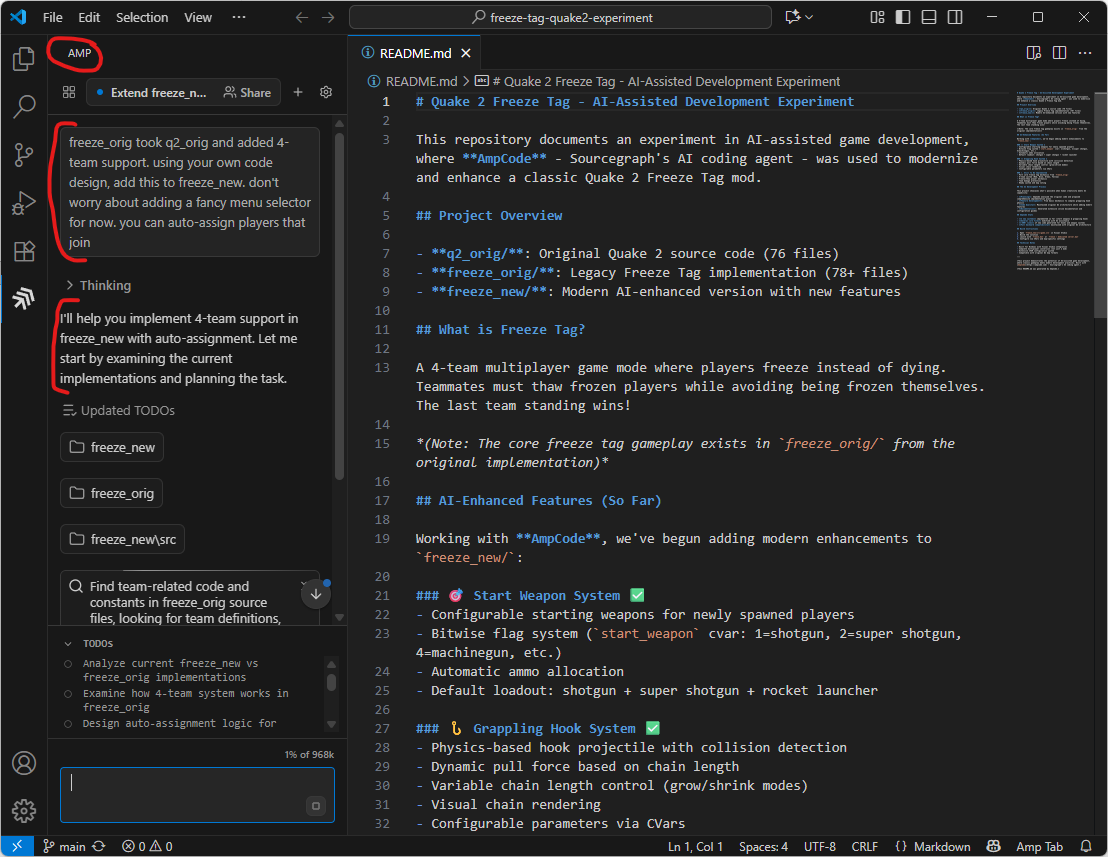
Working with Amp is rather exciting. You can see in this picture me talking to Amp on the left. I like that it’s built into VS Code. I like that you can watch it work and it talks as it goes. I can even be in another window watching it generate code changes on my local hard drive. Once it’s done a change I’ve tested and like, I ask it for a Git commit msg and push the changes.
Frustrated By AI
Don’t get me wrong. Today was very exciting for me. I feel like an AI Wrangler or AI Whisperer. Perhaps if I could just correctly tell the AI what to do, it would generate correct output. I plan to get better at talking to AI.
However I do see a fundamental problem with AI currently. AI doesn’t ask questions back before it runs off and does something. For example, when I asked it to make a grappling hook, it would be nice if it paused and said “it looks like the original hook was off-hand and not a main weapon, do you want it to be off-hand?” Right now the AI just assumes. I suppose it has to. If it didn’t assume a great number of things, it would never move forward.
I actually stopped what I was doing and looked into this and it appears there’s a group of people researching making AI more “Socratic” (have it ask questions to arrive at an answer). Why does this matter? Working on this project and this blog plan cost me about twenty bucks for the AI to come up with the code. If AI is running off to churn out an answer for me (and that time costs me money), I want it to make sure it understands the assignment correctly.
Conclusion
Maybe I have it all wrong. I am just starting out. Maybe I need to use words like “tell me what you plan to do” before I ask Amp to implement. This is actually pretty funny because it makes me think of the Nonviolent Communication concept: “when I heard you say x, I felt y”. I need to start asking AI “what do you think I’m asking you to do?”. Actually I have been doing that with ChatGPT. I will ask it “what’s a better way to ask you this?”
Regardless, this entire activity has been very educational and only cost me a few coffees! I can’t wait to work with Amp more.
Source at GitHub (Amp generated all the documentation)
Update: Now that I’ve gone through this exercise I’ve started reading what other people are doing with LLMs. Found this very interesting article.
The other day I was messing with ChatGPT and it was able to analyze a Beyond Compare diff of two different source trees and it looked like it was able to explain in detail what my Freeze Tag changes were to the original code. Today I wanted to see if I could move beyond that and actually start getting some type of AI somewhere to write code for me. Today I found AmpCode.
Getting Set Up
First I installed Visual Studio Code and the Amp Extension by Sourcegraph. I also started with a copy of original Quake 2 source code, and my Freeze Tag modified source code.
Step 1
I told Amp to “please compare (original Quake 2 source code dir) and (Freeze Tag modified source code dir)”. I then told it to take the (original Quake 2 source code dir) and turn it into Freeze Tag. It started to go to work. Things were happening. I looked at the output in another folder and started to realize, it was just moving the differences over! Why I could do that. What’s going on?
I told Amp “you’re not actually doing what i needed. you are just doing a one-to-one line by line copy of the code. what if i wanted you to implement a freeze-tag like mod with your own code, and not by copying my code. can you make your own implementation?”. It then said something that made my jaw drop. I’ll print the whole output here:
Ah, you're absolutely right! I was just doing a mechanical copy-paste instead of actually implementing freeze-tag mechanics. That's much less interesting and educational.

Let me implement freeze-tag from scratch based on understanding the gameplay:

Freeze-Tag Game Mechanics:

Team-based (red/blue/green/yellow teams)
When shot by enemy, player gets "frozen" instead of dying
Frozen players stand still in animation, can't move/shoot
Teammates can "thaw" frozen players by standing near them
Win condition: freeze entire enemy team
Additional features: grappling hook, team commands, ready system
My Implementation Plan:

Core freeze mechanics - freeze/thaw player states
Team system - assign players to teams, team damage rules
Freeze animations - visual feedback for frozen state
Thawing system - proximity-based teammate rescue
Win detection - check if entire team is frozen
Commands - team switching, ready system
Game flow - rounds, intermissions, scoring
Want me to implement this from scratch? I'll write clean, modern C code with my own logic and structure, just using the original as reference for the game mechanics concept.
This response made me freak out. Am I out of a job? Let’s see what it can do! I said “yes” and away it went. It was kind of cool that I could watch it work. I almost felt like I was doing one of those “code alongside people” things people talked about. After it had churned away for a while I looked at what it had produced and was impressed, but I noticed a lot of stuff had not been implemented. I told it “i feel like you missed a lot. for example the original freeze tag implemented a four team system but you only support two currently. can you fix this?” It then said sure and implemented four teams. I then went more generic: “can you look over the original implementation again and see if you missed anything?” It replied with:
You're right, let me take a more thorough look at the original freeze tag implementation to see what I missed.

Wow, I can see I missed A LOT! The original has:

Grappling hook system (lines 11-26, 52-55)
Weapon configuration system (lines 32-39, 59, 123-163)
Ready system (line 63, 129-130)
Voting system (line 62)
Map rotation system (line 61)
Team change commands (lines 165-200)
Spectator support
Much more complex freeze state management
So I said “make it so!”. It started working away. It went and implemented each feature. Then I asked “you’ve learned a lot doing this work. how can i have you remember what you did for me in future sessions?” and it printed an AGENTS.md. Evidently if I reference this in the future it can pick up where we left off.
Future
I now see the work flow I need to do. The problem is I still don’t have a working copy of Quake 2. Strike that, I have a working copy, I just can’t get a copy to work with something I’ve built, so I can’t test my code. Technical: Quake 2 Remastered doesn’t have a Dedicated Server so I’m not going to use that. I couldn’t for the life of me get a build to work with yquake2. I was then looking at Q2PRO but eventually decided to move over to Quake 3 for now. My workflow will be: start with original code, ask Amp to implement a feature at a time. Test it, commit to GitHub and keep moving forward. I can’t wait for the future. Another technical note: on working with Amp it looks like my free $10 credit was used up and I had to feed it another $5 to keep working. I felt like I was paying an Intern to code for me.
First Impressions
I’m very impressed with Amp, so much so that I’m nervous for the future. Yes it was coding based on what it saw my original code do, but the fact that it even seemed to understand anything that was going on still blows me away.